
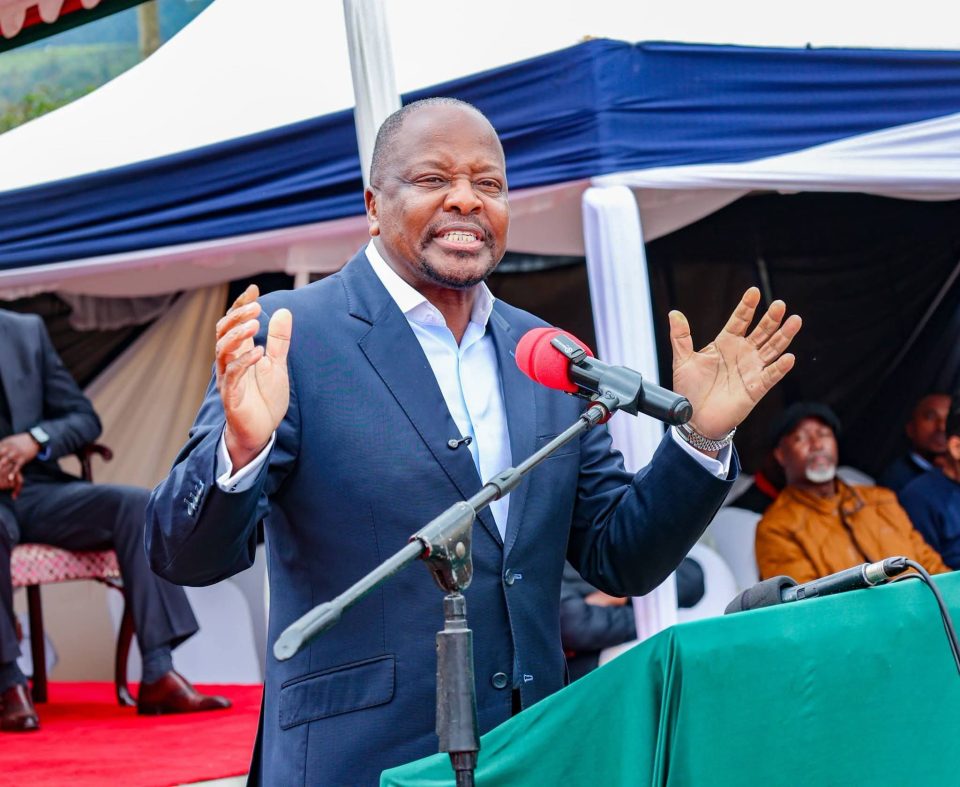
Kagwe made the remarks while handing over Africa’s first Japanese Sencha tea factory to Kirinyaga tea farmers af Kangaita factory.
Agriculture Cabinet Secretary Mutahi Kagwe has dismissed claims that the Tea Levy is hurting Kenya’s tea industry, revealing that tea uptake has surged to 93 per cent, its highest level in years.
Defending the levy, Kagwe insisted the levy is critical to financing research, global marketing and value addition that will secure the sector’s future.
Speaking during the handover of a KSh360 million Japanese-funded Sencha green tea processing factory at Kangaita Tea Factory, Kagwe said assertions that the levy has created a tea glut are false and contradicted by market performance.
“Tea uptake has increased to 93 per cent compared to the levels witnessed three years ago. It is therefore not true that the Tea Levy has caused a glut,” CS Kagwe said.
He said the 0.08 per cent Tea Levy is not imposed on farmers but on tea buyers, and will provide the financial muscle needed to aggressively market Kenyan tea in new and emerging export destinations, fund research into improved tea varieties, strengthen climate resilience and promote value addition,
“Where will the money to promote Kenyan tea in international markets come from if we refuse to support the Tea Levy? Let us be honest—it is not the farmer paying this levy. It is the buyer.”
CS Kagwe argued that Kenya cannot expect to remain the world’s leading exporter of black tea while underinvesting in market development and innovation, saying sustainable financing is essential if farmers are to earn more from their crop.
He noted that ageing tea bushes have continued to reduce yields and quality in many tea-growing areas, making research into new, high-yielding and climate-resilient varieties more urgent than ever.
To demonstrate the government’s commitment to value addition, Kagwe officially handed over the KSh360 million JICA-donated Japanese Sencha Green Tea Processing Factory to Kangaita tea farmers after the project remained idle since 2019 due to an ownership dispute.
“This factory now belongs to the farmers of Kangaita. That is the message I was given by President William Ruto himself. We could not allow such an important investment to remain dormant while farmers waited to benefit.
“The facility is the only factory in Africa producing authentic Japanese Sencha green tea, positioning Kenya to tap into premium global specialty tea markets where prices can reach up to USD10 per kilogramme.
CS Kagwe thanked the Government of Japan, JICA and Japanese taxpayers for the investment, saying the project represents the future of Kenya’s tea industry through technology transfer, premium processing and higher farmer incomes.
He said value addition would not only increase export earnings but also create employment opportunities for young people.
“The children of tea farmers must also benefit from this industry. Value addition creates industries, creates jobs and ensures the next generation sees agriculture as a profitable enterprise.
“The Cabinet Secretary further announced that Japan will continue supporting technical training to enable Kenyan experts to master Sencha tea production and establish Kangaita as a continental centre of excellence in specialty tea manufacturing.
He also called for stronger protection of Kenya’s identity in international markets through Geographical Indications, saying some countries continue to package and sell Kenyan tea as their own.
CS Kagwe reaffirmed the government’s commitment to investing Tea Levy proceeds back into the sector through research, market promotion, innovation and farmer empowerment, saying the ultimate beneficiaries will be tea growers across the country.
